
Why 70% of positioning strategies never make it past Marketing
Five ways to turn strategic documents into the way your company actually operates


👋 Hi! It’s Jennifer. Welcome to my fortnightly newsletter where I challenge conventional business wisdom to help you become a different kind of thinker, leader and operator.
Did a friend forward this to you? Subscribe below to get my emails directly in your inbox.
Read time: 4 min.
Your positioning strategy is sitting in a beautiful deck somewhere.
The messaging framework is done. The story is clear. Marketing updated the website.
Three months later, the numbers aren’t going up as you expected.
You wonder if there’s something wrong with your positioning strategy. Maybe you should go back to the way it was?
The positioning work isn’t the problem. What you do after the documents are delivered - that’s where most companies fail.
Most leaders assume that when the documents are delivered, Marketing will take care of the rest. Leads will start rolling in. Revenue will increase.
But positioning doesn’t work that way.
The foundational work - positioning, messaging, and story - is just the beginning. Making it come alive across your organization is where the real work starts.
Strategy Execution Specialist, Lisa Carlin, found that 70% of strategic initiatives fail to achieve their intended outcomes. Not because the strategy was wrong, but because companies never built the systems and behaviors to make it real.
The foundational work becomes a presentation someone shows at a meeting, then files away and forgets.
Here are five ways to make your strategy come alive:
1. Make leadership the champion (not marketing)
Marketing often drives positioning projects in sales-led B2B companies.
But Marketing can’t be the sole champion.
Positioning influences every major decision - which deals to pursue, what to build next, who to hire, how to structure customer success.
Marketing doesn’t have the power to make those calls. Only leadership does.
61% of companies struggle to bridge the gap between strategy formulation and day-to-day implementation. The disconnect happens when leadership treats positioning as a marketing deliverable rather than a company-wide operating principle.
Leadership’s job is to keep positioning top-of-mind by putting it on every leadership meeting agenda:
Reviewing the product roadmap? Ask: “Does this support our positioning?”
Sales brings a deal? Ask: “Is this our ideal customer?”
Hiring someone new? Ask: “Will this person strengthen what makes us different?”
When leadership treats positioning as a priority, the organization follows.
2. Give the strategy time to work
Impatience kills more positioning strategies than anything else.
Positioning is a long-term game, not a one-time event.
Sara Santanen, a positioning consultant at Fletch PMM, points out that B2B sales-led companies need to commit to 18-24 months before fairly evaluating results. Yet most execs want results within 3 months.
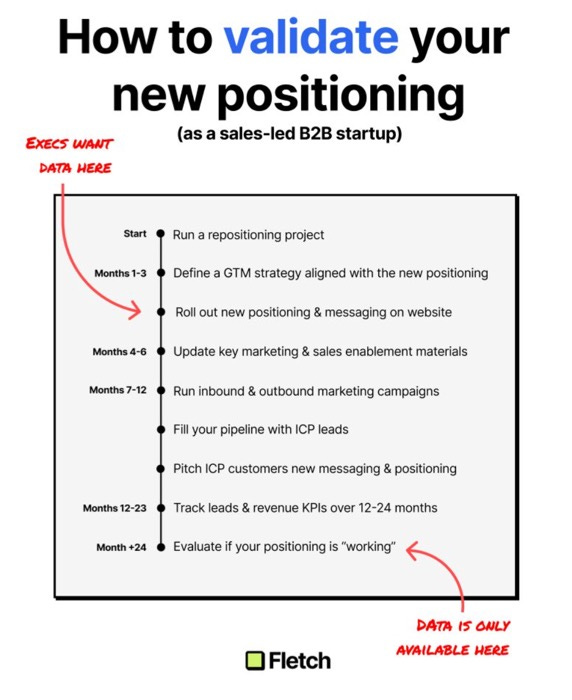
18-24 months can feel like forever, especially when you’re answering to a board or investors.
But consider what you want to happen.
You’re asking the market to see you differently. You’re asking prospects who’ve never heard of you to understand a new approach. You’re asking your team to work in completely different ways.
All of this takes time.
The companies that win are the ones willing to stay the course long enough for positioning to take root.
3. Update every system that touches customers
Positioning changes everything about how you operate.
You will most likely have a new ICP (ideal customer profile). And your new ICP is vastly different from your old way of targeting. They have different needs, different challenges, different expectations.
For example, a B2B manufacturing company with 150 employees operates nothing like a startup with 10 people, so you have to treat them differently.
Audit and update:
Sales pitch and discovery process
Demo flow and what you highlight
Product roadmap priorities
Marketing and sales playbooks
Onboarding
Support practices
Contract structures
I worked with one company where we completed the strategic foundations, updated the website, developed a new content strategy, and created a new sales pitch with the updated positioning and messaging.
A couple of months later, I discovered the sales team was still using the old approach. They were leading with features and functions, demoing to anyone who’d listen, and closing deals with customers who didn’t fit the new ICP.
When I asked why, the sales director said, “The old way works. Why change it?”
This is where strategy dies.
The positioning existed on paper, but the systems that bring it to life hadn’t changed. And without changing the systems, the old behavior persisted.
4. Practice until the new language becomes natural
Sales teams are usually the first to interact with customers. This can be through email, phone, discovery calls, demos, etc.
How they communicate and what they communicate must align with your story. But that alignment doesn’t happen automatically.
Change is uncomfortable. And people usually prefer what they know, especially under pressure. A rep who’s trying to reach quota at the end of the quarter will default to whatever worked before.
Research shows that 20% of staff members actively resist implementation initiatives, and 45% of leaders say ensuring staff take different actions is the toughest implementation challenge.
That’s why practice matters.
After rolling out the new pitch, schedule role-play sessions. Have sales explain your differentiation in their own words. Record discovery calls and review them together.
Do the same across the organization.
Customer success should practice how they talk about value. Product teams should practice explaining roadmap decisions through the lens of positioning.
Repetition turns strategy into muscle memory.
5. Measure what actually matters
58% of organizations believe their performance management systems are insufficient for monitoring strategy performance, and 92% don’t track the key performance indicators that tell them how well they’re competing.
That’s often because, along with positioning, the KPIs need updating.
Most companies keep measuring what they always have - website traffic, email open rates, social engagement. Those numbers might move, but they don’t tell you if positioning is working.
Instead, measure:
Attraction: % of inbound leads that match your ICP
Conversion: Win rate for ICP vs. non-ICP deals
Retention: Customer retention by segment
Advocacy: Referral rates and quality of referrals
Efficiency: Sales cycle length for ICP deals
Set up a dashboard that tracks these monthly. Review with the leadership team.
When you spot trends, good or bad, adjust your systems accordingly.
The positioning work you’ve done matters (but only if you implement it)
Most companies stop at the surface. They update the website, refresh the messaging, announce the new direction, and then wonder why nothing changes.
The difference between companies where positioning takes root and companies where it dies on a slide deck comes down to sustained, systematic implementation.
You don’t need to change everything overnight.
Pick one system to rebuild this month. Maybe it’s your sales deck. Maybe it’s onboarding. Maybe it’s how you discuss the product roadmap internally.
Next month, pick another.
This approach feels slow, but it compounds. Each aligned system reinforces the others.
Sales conversations get easier when they match what marketing promised.
Customer success gets smoother when onboarding sets clear expectations.
Product development gets clearer when everyone knows who you’re building for.
The best companies commit to the work, one system at a time, until positioning becomes how they operate.
That’s how strategy becomes reality.
So much wisdom and great advice here. ⭐ Thank you for sharing, Jennifer. 🙏
I was just listening to two webinars this week that made the points about needing to ensure systems and structures are in place, and to take the time needed to assess impact. Change and uptake will be slow at first, but like the lilies that double every day, over time the exponential change can be huge.